
Principles of Motor Learning and Multisensory Cueing – Not Just for Apraxia
The principles of motor learning and multisensory cueing is an important part of effective treatment not only for childhood apraxia of speech (CAS), but also for other speech sound disorders. The literature regarding incorporating the principles of motor learning and …

Overview

The principles of motor learning and multisensory cueing is an important part of effective treatment not only for childhood apraxia of speech (CAS), but also for other speech sound disorders. The literature regarding incorporating the principles of motor learning and multiple senses for better retention will be briefly reviewed. A variety of auditory, visual, tactile, semantic, proprioceptive and kinesthetic strategies to elicit accurate speech production will be demonstrated. Clinical decision making for what types of cueing to use in different contexts will be covered and a cueing hierarchy will be discussed. Fading cueing and the reasoning behind fading cueing based on motor learning literature will be covered. Examples of cues for a variety of movement gestures will be demonstrated and the opportunity for participants to share their own techniques will be provided.
Following this course, participants will be able to:
- Name and describe 3 types of visual cues.
- Describe at least 3 ways to decide what type of cueing to use based on a child’s error.
- Describe the rationale for using multisensory cueing.
This course meets the requirement for Professional Development hours towards your ASHA renewal since it is approved by TSHA! You can count these hours towards ASHA renewal when you submit your Compliance Form.

Curriculum
Curriculum
- 4 Sections
- 3 Lessons
- Lifetime
- 01 - Handouts1
- 02 - Video Link1
- 03 - Post-test1
- 04 - Course Evaluation1
Instructor

Target audiences
- SLP/Assistant/Student
People who took this course, also liked the following:
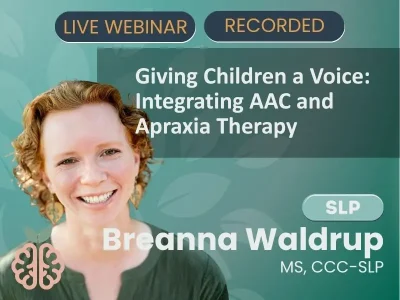

December 4, 2026 – LIVE WEBINAR – Giving Children a Voice: Integrating AAC and Apraxia Therapy
December 4, 2026 | 12:00 PM-1:00 PM CST Many children with childhood apraxia of speech (CAS) utilize alternative and augmentative communication (AAC). The focus...


October 30, 2026 – LIVE WEBINAR – When Disfluencies are Present – Is it Stuttering or Apraxia?
October 30, 2026 | 12:00 PM-1:30 PM CST The presence of disfluencies in a child’s speech may be indicative of difficulties motor planning/programming. In...

Diagnosing Childhood Apraxia of Speech in Autistic Children
Clinicians often suspect a motor speech disorder, especially childhood apraxia of speech (CAS), in autistic children who are minimally speaking. Differentially diagnosing a speech...


Childhood Apraxia of Speech: Meeting a Child’s Needs in the Home Health Setting
Evaluating and treating Childhood Apraxia of Speech (CAS) is complex. It requires extensive training to fully understand all of the variables involved. Applying that...

What to Do in Early Intervention When You Suspect Apraxia (CAS)
Many speech-language pathologists working with the early intervention (under age 3) population in the home and private clinic settings encounter children they suspect of...

Course Features
- Lectures 3
- Quiz 1
- Duration 1.5 hours | 0.15 CEUs/CCUs for SLP
- Skill level All levels
- Language English
- Students 7
- Certificate Yes
- Assessments Self